

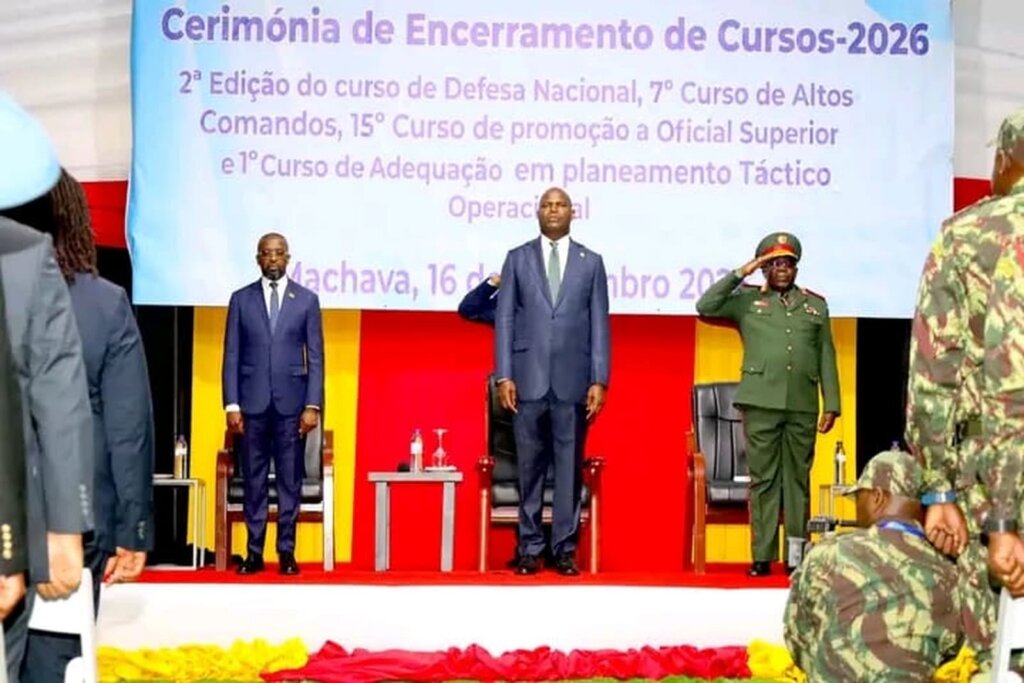
The President of the Republic and Commander-in-Chief of the Defence and Security Forces (FDS), Daniel Chapo, has called for the establishment of a national defence industry capable of producing equipment and developing technologies to enhance the country’s security and reduce reliance on external resources.
This challenge was presented on Monday, 16 November, in the municipality of Matola, Maputo province, during the closing ceremony of multiple defence courses, including the Second Edition of the National Defence Course, the Seventh High Command Course, the Fifteenth Senior Officer Promotion Course, and the First Course in Tactical-Operational Planning, delivered by the Armando Emílio Guebuza Defence Studies Higher Institute (ISEDEF).
Chapo emphasised that these training programmes are a strategic investment for the nation, contributing to the development of human capital and strengthening national capabilities in defence and security. He highlighted that the knowledge gained by participants should translate into increased competence, responsibility, and effectiveness in carrying out missions, particularly in combatting terrorism.
To achieve the establishment of a national defence industry, Chapo urged the Ministries of National Defence and Interior, as well as the State Information and Security Service (SISE), to collaborate in implementing the project.
The President also proposed the creation of a Technology Research and Innovation Centre to assist the government in operationalising the defence industry and in producing technological prototypes, including drones, unmanned aerial systems, ground robotic systems, precision weapons, geospatial intelligence systems, and cyber defence solutions.
Acknowledging the high costs associated with modern military equipment, Chapo insisted that defence and security institutions should seek strategic partnerships to realise the initiative.
In addressing the ongoing situation in Cabo Delgado, Chapo recognised the persistent pockets of violence in the region, while also noting improvements in security, evidenced by the gradual return of populations to their original areas previously affected by the presence of terrorist groups, particularly in the districts of Mocímboa da Praia, Macomia, and Quissanga.
However, he clarified that such developments do not mark the end of terrorism in the province, underscoring that the current scenario represents an improvement over previous conditions. Chapo attributed these advances to the bravery and courage of the young members of the Defence and Security Forces, along with contributions from members of the Local Force and allied forces from Rwanda and Tanzania participating in counter-terrorism operations.