
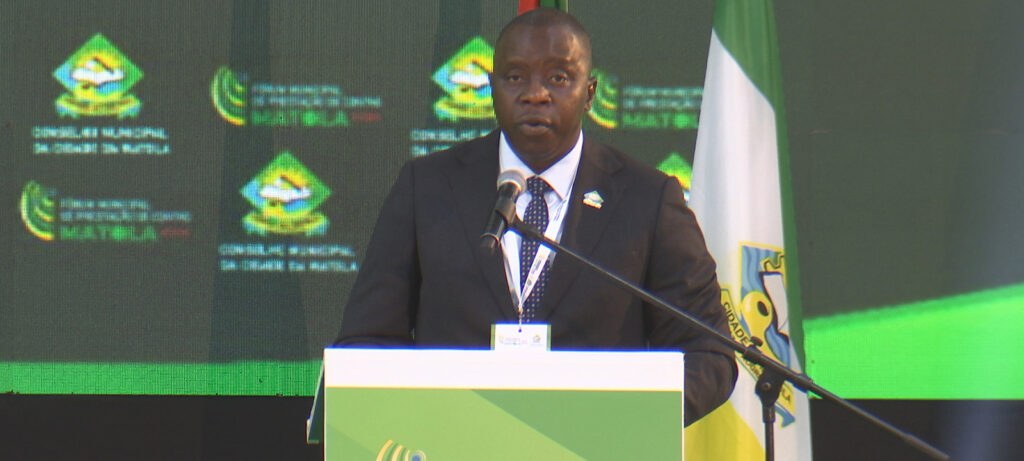
The Matola Municipality has reported a 32.6% increase in its own revenues for the first half of 2026, compared to the same period last year, reaching 498 million meticais. This follows revenue figures of 646.6 million meticais in 2024 and 632.5 million in 2025, as detailed by Matola’s mayor, Júlio Parruque, during an accountability forum for residents.
Key revenue sources included the Municipal Property Tax (IPRA), contributing 28%, followed by waste collection, disposal, and treatment fees at 15%, urban transport fees at 6%, and both the SISA tax and the Municipal Personal Tax at 5% each. Economic activity fees accounted for an additional 3% of total revenues.
Parruque also highlighted the introduction of an electronic payment system across 51 municipal markets as part of ongoing efforts to modernise collection mechanisms and enhance revenue control.
In addition, the municipality has secured external funding, including approximately 1.5 billion meticais from the World Bank through the MOVE Project, 150 million meticais from Japan’s International Cooperation Agency (JICA), 35 million from the Road Fund, and 1.4 million from Spanish Cooperation in the FAMSI project.
On the expenditure side, the municipality spent 1.53 billion meticais in 2024, 1.72 billion in 2025, and 661.9 million in the first half of 2026.
Parruque noted that effective financial management has ensured the timely payment of salaries and the thirteenth-month bonus to 1,307 municipal employees, along with settling back payments of 111.4 million meticais linked to the Single Salary Table (TSU), benefiting 838 staff members and local assembly members.
In terms of infrastructure and urban planning, efforts were made to mitigate flooding, a significant challenge during the rainy seasons of 2024/2025 and 2025/2026. Completed drainage systems include the Colector da Liberdade and others in the Molumbela area.
Work continues on various roads, including Avenida 5 de Fevereiro and initiatives within urban areas such as Matlemele-Nwamatibjana and Matlemele-Matola Gare.
The municipality reported advancements in its road network, noting construction, rehabilitation, and earthworks along Avenida das Indústrias, the Zona Verde-Ndlavela stretch, and the Circular-Mucupe connection.
In land management, 7,608 plots were regularised, 4,311 construction projects licensed, and 3,761 provisional titles and 489 definitive titles issued. The municipality also authorised 92 high-rise construction projects and 28 multi-family buildings, as well as resettling 257 families affected by flooding.
On solid waste management, the municipality expanded its fleet with 20 new refuse collection trucks, four street sweeping vehicles, and additional waste containers, while implementing night-time waste collection.
Other actions included planting 10,000 trees, rehabilitating public squares, improving the Matlemele landfill site, and cleaning critical drainage areas across the city.
Regarding urban mobility, the municipality introduced 50 new buses and eight articulated vehicles, alongside the launch of 22 new routes. Additionally, 205 motorcycle taxi drivers received training, complemented by initiatives aimed at enhancing women’s participation in the transport sector through projects like “Nsati Boss” and “Mulher ao Volante.”