
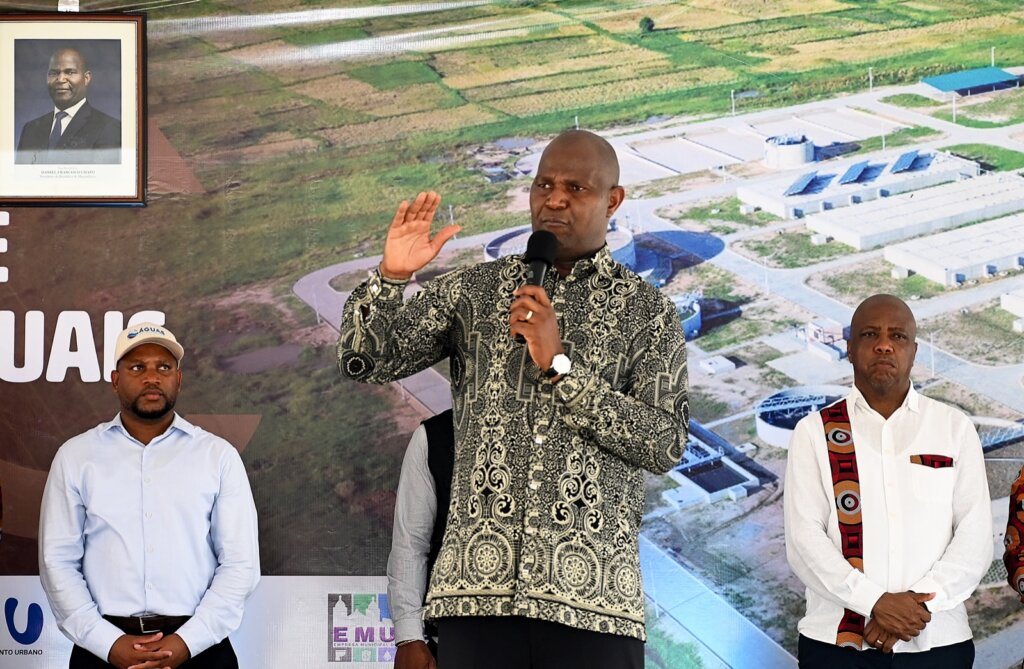
The President of the Republic, Daniel Chapo, has announced that the inauguration of the Wastewater Treatment Station (ETAR) and the Sewage Network in Quelimane will significantly enhance public health and living conditions for residents by mitigating environmental contamination and diseases such as cholera and diarrhoea, previously linked to untreated waste discharge.
This infrastructure project was unveiled at the start of a three-day working visit by the President to the Zambézia province, part of a broader agenda focused on promoting participatory and inclusive governance.
In his address, President Chapo noted that the geological characteristics of Quelimane, particularly the high groundwater levels, posed challenges for the effective treatment of wastewater, necessitating the construction of a system aimed at safeguarding public health.
The initiative was realised through collaboration between the Central Government, the Provincial Government, and the Municipal Council, with financial backing from the World Bank.
The President emphasised the need to expand the capacity of water supply and sanitation systems in the city, which currently serve around 19,000 residents within an estimated population of 400,000. He acknowledged that this coverage remains insufficient and advocated for continued investment to enhance system capability and extend household connections in underserved neighbourhoods.
He also raised concern about the environmental and health issues arising from the disposal of untreated wastewater into the River dos Bons Sinais, a vital resource for fishing, laundry, and other daily activities. He explained that the previous situation had contributed to health crises, including cholera and diarrhoea outbreaks that have resulted in fatalities. The operationalisation of the new treatment station is expected to progressively alleviate these challenges in the affected areas.
Furthermore, the President highlighted the social benefits of access to safe and abundant water. He claimed that with improved availability at home, women can devote more time to agricultural production, while children can focus on their studies. The time previously spent searching for water can now be utilised for productive and educational purposes, enhancing family organisation and well-being.
He urged the Municipal Sanitation Company to maintain and preserve the infrastructure, advocating for the expansion of water connections to currently unserved areas. The President also called on residents to consistently pay their utility bills, stressing that these revenues are crucial for covering electricity costs, purchasing treatment products, maintaining equipment, and compensating workers.
As part of the Wastewater Treatment Station project, household connections were established for approximately 2,000 families, alongside the construction of three pumping stations and 127 household latrines in the Mapiazua neighbourhood. Additionally, 45 kilometres of conventional network and 15 kilometres in peri-urban areas were completed. At the peak of construction, the project generated over 400 temporary job opportunities, including 32 roles occupied by women.